

Keycap profiles explained: Cherry, OEM, SA, DSA and XDA
How Cherry, OEM, SA, DSA, XDA and other keycap profiles differ in height and row shape.
Key takeaway
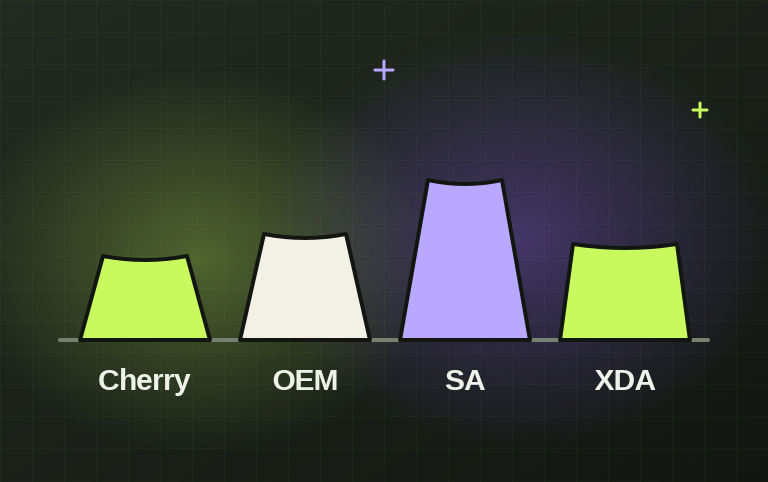
A keycap profile is the shape and height of the caps. Cherry is low and sculpted. OEM is a little taller and common on stock boards. SA is very tall with a rounded dish. DSA and XDA are uniform, so every row is the same shape. Profile changes feel, and it changes which single keys you can swap between rows.
Two words describe most profiles. Sculpted means each row has its own height or angle. Uniform means every row is the same. That one difference decides how forgiving a set is when you move keys around.
Keycap profile comparison chart
| Profile | Height | Rows | Notes |
|---|---|---|---|
| Cherry | Low | Sculpted | Cylindrical dish. Common on GMK sets |
| OEM | Medium to tall | Sculpted | Cylindrical tops. Familiar from many stock boards |
| SA | Very tall | Usually sculpted | Prominent spherical dish and a retro look |
| DSA | Low to medium | Uniform | Spherical dish. Practical for ortholinear layouts |
| XDA | Medium | Uniform | Wide top surface with a shallow dish |
| MT3 | Tall | Sculpted | Deep spherical dishes |
| MDA | Medium | Sculpted | Spherical tops, lower than a typical SA set |
| ASA | Medium to tall | Sculpted | Akko’s rounded, SA-inspired shape |
Heights are approximate. Compare the maker’s row diagram when you mix profiles or replace a single key.
Sculpted vs uniform keycap profiles
- Sculpted sets fit the curve of your fingers across rows, but a key only belongs in its own row.
- Uniform sets let you put any 1u key anywhere, which helps on unusual layouts.
- Cylindrical tops curve mainly one way. Spherical tops form a shallow bowl.
How I choose a keycap profile
I start from what I already type on. Many stock boards use OEM, and Cherry is a little shorter than that. SA and MT3 are a bigger change, and I’d try a few keys before buying a full set. For a board with odd key positions, I’d look at DSA or XDA first. Profile is one of the things that shapes sound, which I cover in do keycaps change the sound of a keyboard.
Profile and fit are separate checks
Profile tells you the shape. It doesn’t tell you whether the stems or key sizes match your board. Run the fit checklist as well. For a rounded profile in a real set, see my Akko ASA-Low review.
My conclusion
Cherry or OEM is the safe pick if you want something familiar. Go uniform if you move keys around. Go tall and spherical only once you’ve felt it.
FAQs
What is the most common keycap profile?
OEM is the familiar shape on many stock keyboards. Cherry is common on aftermarket sets.
What is the difference between Cherry and OEM profile?
Both are sculpted with cylindrical tops. Cherry is shorter than typical OEM.
Can I mix keycap profiles on one keyboard?
You can, but heights and angles will differ between keys. Compare the row diagrams first, especially for sculpted sets.